TABLE OF CONTENTS…
01 About Philosopher Kings.
02 From the Founder.
03 Plato’s Utopia and the Philosopher King.
04 Why Impossible Ideals are Essential.
05 What a Philosopher King Looks Like in the Wild.
07 A New (Old) Class of Professional.
08 The intersection of Knowledge. Virtue. Wisdom.
09 A Tool. A Book. A Mantra.
10 Bonus Article: A Young Professionals Personal Finance Crash Course.
ABOUT PHILOSOPHER KINGS...
PHILOSOPHER KINGS is the creative work of Mark Shaffer— a training and education platform built to help you become as confident in your inner character and interpersonal skills as you are in your professional expertise. We teach you to think, speak, and act with knowledge, wisdom, and virtue. Our trainings and products focus on Emotional Intelligence, Relational Health, Core Professional Competencies, Work-LifeBalance, and Long-Term Legacy/ wealth creation.This isn’t just about getting better at your job. It’s about becoming the kind of person whom people trust, follow, and remember.
The design is simple: profound help any young professional or early career person can afford. We built Philosopher Kings because we deeply care about and are for the up and coming generation of leaders across the professions. You have been given less advantages, less opportunities, and higher expectations— we want to help you become excellent.
The Philosopher Kings Memo is a much-needed break from the dense, technical reading your profession constantly demands. In just a few pages each month, you’ll find fun, thoughtful, and surprisingly profound reflections designed to spark real growth— both personally and professionally. If you take the time to think through and apply the ideas inside each Memo, we believe your life will start to change. Monthby month, you’ll raise your standards forwisdom, character, and clarity. And overtime, that inner growth will set you apart—not just as a capable practitioner, but as a world-class professional others trust and admire.
Each Philosopher Kings Memo edition has a link to a short but impactful coaching training with Mark— a video training with follow up deep work. The goal is to be better than coaching programs that cost thousands of dollars, for the cost of a few coffees together.

FROM THE FOUNDER.
The Philosopher Kings Memo has one big goal: to help you grow in practical wisdom and virtue. It’s not just about tips or tricks— it’s about building the kind of inner foundation that lasts. And so how far can I take you in a half-hour of engaging reading quality content? Let’s just see...
Professional schools are often brilliant at pouring knowledge into students. They train your hands and fill your head— but rarely shape your character. Sorry not sorry. That’s where the Memo comes in. We’re here for the rest of you: the part that has to lead, respond, adapt, and serve with depth and integrity.
This issue is all about foundations. What did Plato imagine when he dreamed up the Philosopher King? Why did he believe a person who prized thinking, speaking, and acting with wisdom, knowledge and virtue, was uniquely qualified to lead a flourishing society? And what does that ancient vision have to do with how we work, serve, and show up in the modern professional world?
In short: everything. It’s what gets me up in the morning. It’s why I do what I do.
My clients don’t just get better at what their profession — they become uncommonly excellent human beings. They grow in clarity, calm, and character. The sooner you begin that journey, the sooner you’ll notice a deeper presence in your very way of being in the world— not only as a professional, but as a whole person.
Let’s keep growing in wisdom together,
Mark Shaffer
Ph.D. in Classical and Ancient Near Eastern Literature. Founder of Philosopher Kings, LLC.


According to Plato, three qualities mark a true Philosopher King: knowledge, wisdom, and virtue.
A young professional who possesses these qualities will outshine everyone around them...
Plato’s Utopia and the Philosopher King.
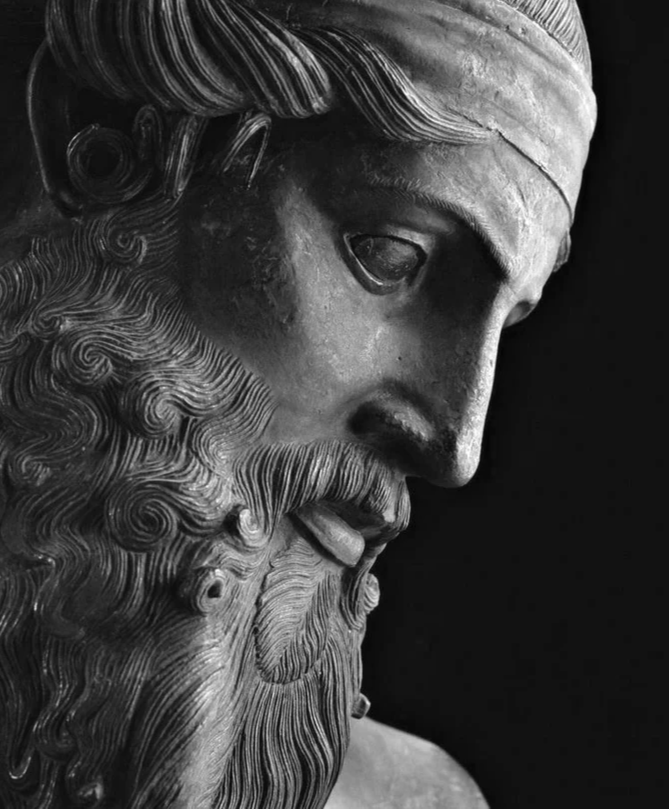
Plato taught his students that in an ideal society— what he called Utopia— politicians wouldn’t be the ones in charge. Instead, philosophers would rule as kings. Why? Because they’d be guided not by a thirst for money, sex, or power, but by a deeper commitment to truth and virtue. Plato coined the term Philosopher King to describe this rare kind of leader: someone impervious to corruption, devoted to wisdom, and a master of the self before attempting to guide others.
According to Plato, three qualities mark a true Philosopher King: knowledge, wisdom, and virtue. The young professional who possesses these qualities will outshine everyone around them.
Plato’s Utopia and the Philosopher King.
Knowledge. Wisdom. Virtue. The 3 Qualities of Plato’s Philosopher King…
-

Knowledge.
Knowledge is the foundation— the education, training, and credentials that allow you to do your work. It’s what you earned through all those early mornings, late nights, and everything in between. Knowledge gives you the license to serve clients, patients, students, and communities with skill and credibility.
You can't practice without it— but knowledge alone won’t make you excellent.
-

Wisdom.
Wisdom is something else entirely. Wisdom is the art of sound judgment. It’s knowing how today’s decisions echo into tomorrow— in your work, your relationships, your reputation. You don’t get wisdom from textbooks. You earn it through mentorship, real-time choices, and just as often, mistakes. In fact, one of the quickest paths to wisdom is failure—
if you let it teach you. Wisdom isn’t knowing everything; it’s recognizing patterns, asking better questions, and course-correcting with grace.
-

Virtue.
Virtue is the deepest layer. It’s who you are when no one is watching. The ancient Greek word is arete (ἀρετή), which means excellence or goodness. Virtues are internal strengths— justice, courage, humility— that shape how you treat others and live your values. A just person gives others a fair deal. A courageous one speaks up when it would be easier to stay quiet. Virtue is what lets us rise above what is easy, and reach for what is right.
(We’ve got a whole Memo issue coming soon on why the cardinal virtues beat corporate “core values” any day.)

Here’s the problem: modern professional schools are fantastic at developing knowledge, but they often run out of time and tools to cultivate wisdom and virtue. When I talk with faculty and senior partners across industries, two themes come up again and again about young professionals: 1) a lack of professionalism
and 2) a lack of clearly defined personal ethics. In other words: we’re short on wisdom and virtue. That’s where Philosopher Kings comes in.
This isn’t just a coaching platform— it’s a family. A community of modern professionals who are learning to think, speak, and act like a new (and ancient) kind of practitioner. We believe that deep character beats shallow hustle, that inner excellence leads to outward impact, and that the journey is more than worth it— for you and for everyone your life touches.
It’s not a burden. It’s a privilege. Let’s go become the kind of professionals the world actually needs. △
WHY IMPOSSIBLE IDEALS ARE ESSENTIAL.
Let’s be honest: it can feel a little daunting to hear someone suggest that, even after all the schooling, internships, boards, and certifications, you still have a long way to go. Especially when it comes to interpersonal skills, inner character, and wisdom. That’s a hard pill to swallow—I get it. I’ve been there too. So let’s start with the right framing.
When Plato imagined the Philosopher King, he wasn’t offering a job description— he was casting a vision.
His “Utopian Republic” wasn’t a blueprint for government; it was an ideal. Utopia, after all, literally means nowhere. This was an aspirational society shaped by one wild idea: that leaders— the ones with the most power— should also be the wisest and most virtuous among us. Rulers, Plato argued, should first be philosophers.
Now, did Plato believe this could happen in real life? Not really. He knew how rare this kind of person was— maybe impossible. But that’s the whole point. The Philosopher King was meant to be a transformative ideal.
And here’s where it gets personal: the same holds true for you and me.
When we begin to hold the same high standard for wisdom and virtue that we do for technical knowledge, we begin to shift. Not overnight, and not easily—
but deeply. The truth is, most professionals never even consider this. We spend so long acquiring knowledge that we start to believe we’ve arrived. We get attached to being “the expert.” The one with the answers.
But here’s the truth bomb: the practitioner who marries deep knowledge with wisdom, emotional intelligence, and humility? That’s a different breed of cat.
That’s the making of a modern-day Philosopher King.


WHAT A PHILOSOPHER KING LOOKS LIKE IN THE WILD.
At my core, I’m a creative producer. That’s the engine. Everything else— coaching, teaching, curating ancient wisdom— runs off that creative current. When I’m in that “maker-mode,” I feel unstoppable.
But when I’m not? The comedown is steep. I’ve always been that way. Since I was a kid, I’ve ridden the emotional rollercoaster that comes with being a deeply creative person. High highs. Low lows. Art has always been with me, and so has the turbulence.
Last year, though, winter hit harder than usual. (I live in Iowa, where winter is less “magical snow” and more “Better Call Saul slow-burn character death.” If I’m not proactive, I basically binge-watch depression from December to February. Ha— but not ha.)
This time, the low mundane — the non-creative, daily grind part— started to feel impossible. I’ve never taken medication for it. I’ve always felt I could tough it out. But this winter, I sensed I needed help. So I booked an appointment with University of Iowa Hospitals and Clinics.
THE INTERSECTION OF KNOWLEDGE, WISDOM, AND VIRTUE IS WHERE TRUE PROFESSIONALS DO THEIR BEST WORK…
My regular provider was booked three months out.
The scheduler asked if I’d be willing to see someone named Dr. Sidharguntha. I paused. Then said, “Sure, let’s run it.”
Dr. Sidharguntha was a small, soft-spoken man with a thick Indian accent. He entered the room, introduced himself, and— to my surprise— he listened.
...Like really listened.
He asked thoughtful follow-ups. He rephrased what I said to make sure he understood. “Mark,” he said, “if I’m hearing you correctly…” and he’d gently repeat my words back to me.
That alone was healing.
Eventually, he shared a diagnosis of seasonal depression, with a possibility of adult ADHD. But he didn’t just hand it
to me like a prescription slip.

He made it a conversation—
one that left me feeling seen, heard, and grounded. It gave me peace. Real, visceral peace. And then he did something extraordinary.
He asked my permission: “Mark, if you’re willing, I’d like to do three things. First, I’ll explain what I think is happenin physiologically when you experience these lows.”
(Knowledge— every doctor should know this.) “Second, I’d like to share a bit of my own story with depressive seasons.”
(Wisdom— you’ll see why in a moment.) “And third, I want to commit to getting through this together.”
(Virtue— the rare ethical commitment of being with someone, not just treating them.)
And he did. All three.
A week later, he personally called me just to check in.
That was not a normal doctor’s appointment. It felt restorative. It gave me hope. It reminded me what it’s like to be on the receiving end of someone who leads with wisdom and virtue, not just knowledge. He didn’t just “know things”— he knew me. And that changed the entire experience.
So here’s why I’m telling you this:
What Dr. Sidharguntha did— that blend of knowledge, wisdom, and virtue— is the model. That’s the goal.
That’s what we mean by a Philosopher King in the wild.
After you finish this Memo, take a moment to reflect: What would it look like to show up like that — in your office, your classroom, your clinic, your courtroom, your sessions?
What would it mean to lead your entire client or patient process like that?
Because I’m telling you: that’s the kind of professional whom people never forget. △
The intersection of Knowledge. Virtue. Wisdom.
Okay, take a look at this with me. Here is what I believe Dr. Sidharguntha did so right: he remained at all times at the intersection of knowledge, wisdom, and virtue. In the past, my doctors have always had knowledge.
Every single one of them.
I have never had a provider who did not possess the information needed to make a diagnosis.
In fact, sometimes they seem very arrogant or even condescending about their knowledge, which is unfair to everyone they serve.
You see, there is a power imbalance that comes with knowledge, and an average thinker and mediocre professional will p ower-up in some way or another.
This actually shuts your patients and clients down, and erases trust extremely fast.
Not so for Dr. Sidharguntha, and not so for Philosopher Kings like him...
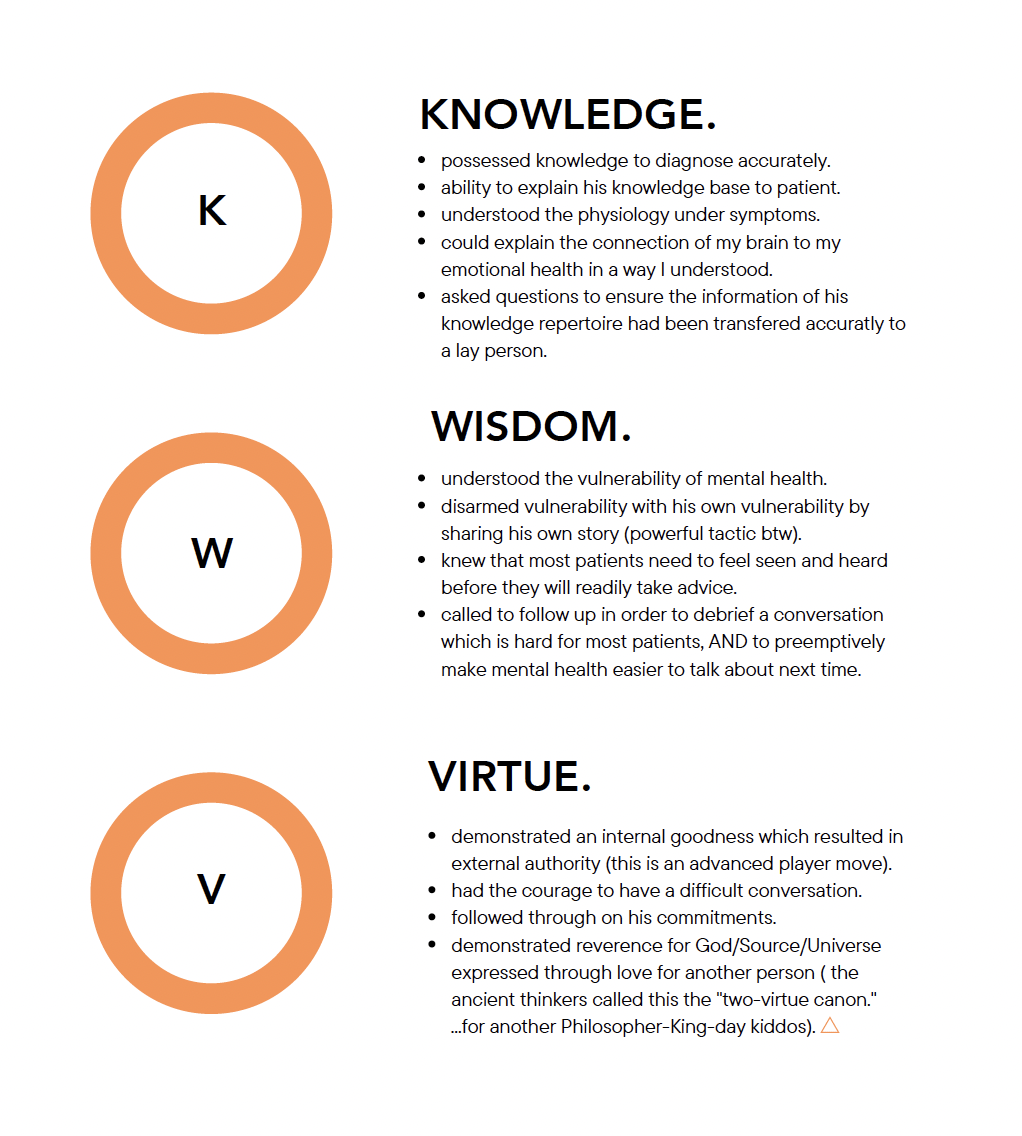
Here is a diagram of how to be like Dr. Sidharguntha, followed by some bullets of each of these philosophical traits which Plato prized and I found so compelling. Study this simple venn diagram and then we'll take it apart.
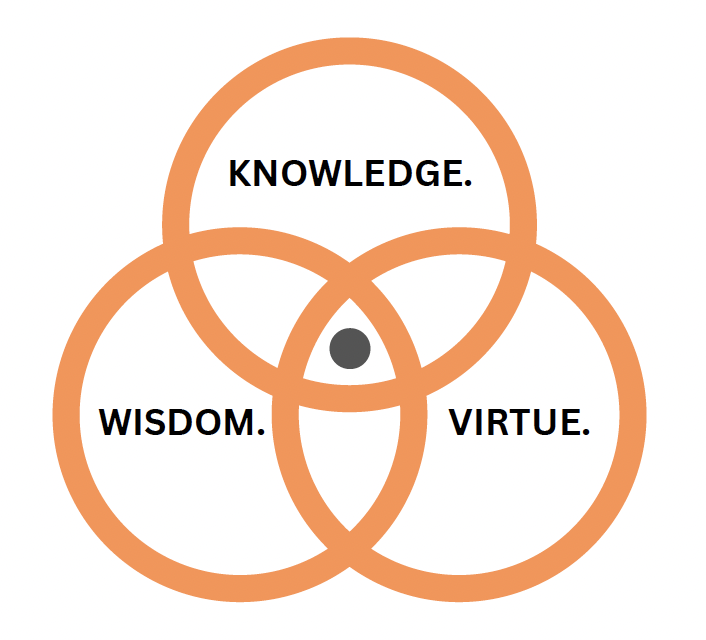
Okay. As promised, Let's break this out into its fundamental pieces. In my estimation, here's what separated Dr. Sidharguntha apart as a Philosopher King. He possessed each of the three pillar-qualities of the philosopher king: knowledge, wisdom, and virtue:

REVERSE ENGINEERING A NEW
[OLD] CLASS of Professional.
A GROWTH HACK FOR GROWING UP AS A YOUNG PROFESSIONAL OR EARLY CAREER RISING STAR…
This is one of my favorite mental models to use with clients. It’s simple, slightly brutal, and weirdly effective. It’s called REVERSE ENGINEERING. Figure out how you would fail on purpose, and do the opposite. This is actually Warren Buffet’s formula for investing too… more on that in a finances issue of the PK Memo down the road..
Okay here goes:
We start by making a list: How to absolutely fail at being the kind of person you want to become. Like, if you wanted to train-wreck your growth as a professional and human being— how would you do it? Then, we flip the script. We reverse engineer what the opposite would look like — and we start building rhythms and disciplines that point us in that direction.
So let’s do it. Here's how to fail at becoming a Philosopher King professional:
2. Assume you’re smarter than your clients.
“People are stupid. Half my job is dealing with how ridiculous they are.”
Not true. You have specialized expertise— that doesn’t make you better, just trained in a specific lane. I’ve spent over a decade in academia and read Greek before breakfast— but I couldn’t explain how my kidneys work to save my life. That doesn’t make me dumb. It makes you important.
So wield that power imbalance with humility and care.
Right direction:
Assume your clients and patients have their own zone of genius. They are capable of radical growth. And when you encounter someone who’s not particularly brilliant? Choose compassion. Honor their dignity.
Wild idea, I know. Ninja turtles and all that. Cowabunga.
1. Make excuses.
“Nobody actually treats clients like that and keeps up with quotas.”
Wrong. YOU couldn’t— yet. That’s because you still need to grow in emotional intelligence and relational health. These aren’t soft skills. They’re essential skills. And yes, it is possible to practice goodness at a decent pace.
Right direction:
Assume it’s always worth your time to make people feel seen, safe, and genuinely cared for. This isn’t fluff. It’s the foundation of trust.
I had to learn this the hard way. Only I didn’t have a Memo like this showing up in my inbox each month (Wink).
3. Pour all your time and energy into knowledge.
“I’m too busy for some kind of philosophy of life or emotional/relational health. You don’t understand my schedule.”
I do. And here’s the truth: the best in your profession don’t have more time than you. They just spend it differently. They make time to grow in wisdom and virtue.
Right direction:
Start now. Become a lifelong student of wisdom (emotional and relational intelligence) and virtue (a rigorous and ethical way of being). And yes—
we make it fun around here.

A Brief Note on Time & Belief.
There are only two things separating you from the professionals you admire most — in ability, wealth, influence, or anything else:
How they spend their time.
What they believe is worth their effort.

If you want to grow into a truly admirable person— not just in skill, but in substance— then you’ll need to invest both time and belief into your own emotional, relational, and ethical development. That kind of investment pays back thirty, sixty, even a hundred-fold.
So I say:
Ad astra.
“To the stars.”
Become the kind of professional who serves the world with knowledge, wisdom, and virtue. A new kind of expert is rising— or maybe a very old one, finally making a comeback.
And I believe your generation has exactly what it takes.
Empathy.
Justice.
Compassion.
A deep desire to heal the world.
Begin a lifelong pursuit of bringing those values into your field. Let’s just see what happens, Philosopher King. ▲

THIS MONTH’S TRAINING.

EACH MONTH, THE PK MEMO FEATURES ONE, ONLINE TRAINING. THE GOAL: MAXIMUM INTERNAL GROWTH IN MINIMUM TIME.
THIS MONTH”S TRAINING:
THE DAILY ALIGNER.
The Daily Aligner is something I use to remember who I am and what I am here to do. DO THE WORK, WATCH YOURSELF TRANSFORM.
The Daily Aligner is your morning ritual for living on purpose. Adapted from the high-performance frameworks used by top consultants and creatives, this tool helps you start each day with clarity, confidence, and inner alignment.
With vision mapping, identity anchoring, and focused affirmations, you’ll train your mind to act from your future self — not your fears.
Don’t just react to the day. Lead it.
LET US HELP YOU CHART THE COURSE FOR YOUR HIGHEST SELF AS A PROFESSIONAL AND A PERSON:
VISION MAP.
A written snapshot of your ideal future— in work, relationships, health, and purpose. This is where clarity starts. If you don’t know where you're going, you’ll drift. This is your map.
VISUAL PROJECTION.
A curated collection of images that represent your future self. Think of it as a vision board with backbone. It’s not fantasy— it’s a focused reminder of who you’re becoming.
CORE VALUES.
These are your personal non-negotiables—the traits and beliefs that anchor you in every decision. They're not buzzwords. They’re your internal compass.
CARDINAL VIRTUES.
The four timeless pillars of ethical strength: Wisdom, Justice, Courage, and Temperance. Practiced by Stoics, early Christians, and classical thinkers—
these aren’t just old ideas. They’re the foundation of integrity.
RULES TO LIVE BY.
Short, sharp truths that shape your habits and decisions. These are your self-written proverbs— principles forged in experience, ready to be lived daily.
PRINCIPLES.
Your bigger beliefs about what makes life meaningful. These guide the way you love, work, lead, and grow. You’re not just building a career— you’re building a philosophy. ▲


You Don’t Have Impostor Syndrome —You’re Just New (And That’s Okay).
You got the job. You got the degree. You’re in the room. So… why do you feel like a fraud?
Here’s the dirty secret of professional life:
everyone feels like an impostor at some point— especially the people who actually care. What you’re experiencing isn’t a crisis. It’s a rite of passage.
And no, you’re not broken. You’re just new.
The Myth of Arrival.
Most young professionals secretly believe that confidence is something that arrives once you “make it.” It doesn’t.
Confidence isn’t something that shows up when you’re good enough. It’s something that grows when you keep showing up, even when you’re unsure. Especially when you’re unsure. The more you wait to “feel ready,” the longer you’ll stay stuck.
The truth is, you’re not supposed to be the expert yet. You're not supposed to have all the answers. That’s why it's called a career path—not a teleportation.
Competence Takes Time (and Reps).
Real confidence comes from competence— and competence takes reps. Early on, you’re still building those reps. Of course you feel awkward. You're not an impostor — you’re in formation.
You’re practicing how to think out loud. How to deliver under pressure. How to read a room. How to keep your footing when someone talks over you in a meeting. This is what the beginning feels like.
“First say to yourself what you would be; then do what you have to do.”
—Epictetus
You don’t need to fake it. You need to grow into it—through time, reflection, and a willingness to be seen learning.
So dive in and enjoy the journey.
And remember, you only gain authority over something when you go through it.
There are no shortcuts to internal growth.
Ditch the Ego, Keep the Standards.
Here’s where it gets tricky: some people try to cure impostor syndrome by pretending they’ve arrived. They puff up. They over-talk. They defend instead of discern. That’s not confidence— it’s costume.
A wiser path is to stay teachable, stay grounded, and stay moving. Let your competence catch up to your calling. And in the meantime, let humility and curiosity be your credentials.
Hold high standards. Just don’t build your identity on having it all together.
A Final Thought.
Impostor syndrome is a sign that you’re stepping outside your comfort zone. That you care. That you're growing. It's not something to be ashamed of — it’s something to walk through with courage and self-respect.
You're not faking it.
You're becoming it.
And in case no one told you yet today— you’re doing better than you think. ▲


A Tool. A Book. A Mantra.
A TOOL.
The Daily Aligner, is a system of future-self clarity and identity alignment which I use myself and give to clients. Each morning begins with a crystal-clear target: a vision map, identity statement, daily affirmations, and a structured routine to center my focus. I’ve found it invaluable for sharpening my sense of self and showing up with more intentionality— not just in my work, but in how I move through the world. In case you missed it, roll back to page 15. The Daily Aligner is this month’s training.
A BOOK.
Mastery by Robert Greene is a powerful companion for anyone who wants to cross the bridge from head knowledge to embodied expertise. Greene makes the compelling case that true masters— after their 10,000 hours of deep practice— don't just refine their field, they redefine it. That’s what sets a master apart: not more answers, but better questions. I’ve found this both true and aspirational. Mastery isn’t the end of the journey— it’s when the real innovation begins.
A MANTRA.
“Better a few minutes late in this world than even a second early to the next.”
I picked this up from Angus, our driver through the Isle of Skye (Scottland), while scouting a potential School of the Wild trek for Philosopher Kings (it turned out to be too intense for 97% of the population— and, apparently, my left knee. Ha!).
Angus had a simple rule for driving mountain passes and crossing uncertain terrain: don’t hurry into danger. I’ve found myself repeating this mantra when rushing to make decisions too quickly, in conversations which are moving too slowly, or whenever I am feeling stress which doesn’t serve me.
The Highlands were beautiful. I took my time. And I arrived exactly when I was supposed to. It’s along the lines of Achilles’ observation from the underworld that he’d rather live a day as a peasant on the face of the earth than a thousand years as a hero in Hades. Agnus’s mantra is less dark though... go with that one.


Crash Course: How to Stop Feeling Broke and Start Building Wealth.
Wealth consists not in having great possessions, but in having few wants.
—Epictetus

You’re smart. You’re talented. You’re finally making money. So why do you still feel broke?
Let’s be honest: most young professionals were never taught what to actually do with a paycheck. You learned how to earn money— not how to keep it. And definitely not how to grow it.
If that’s you, I have good news: your wealth gap is not a character flaw. It’s a strategy problem. You don’t need to make six figures to feel financially grounded— you need a system. So here’s your crash course.

HERE IS A GAME PLAN IN 5 STEPS.
STEP ONE. BUILD A STARTER EMERGENCY FUND (2000$).
Before you invest in stocks, crypto, or your cousin’s dream bakery, you need margin.
A little breathing room between you and the next flat tire or medical bill. This isn’t your retirement fund. It’s your “oh shit” fund.
Your goal? Save $2,000 fast. Sell something. Pick up two weekends of gig work. Cancel a few subscriptions you forgot about. Get scrappy. Having that cushion will calm your nervous system and give you a taste of financial freedom. P.S. This is just as much about the discipline of saving as anyhting else. Time to RETRAIN your relationship to money and develop new habits.
STEP TWO. PAY OFF ALL DEBTS (EXCEPT YOUR HOUSE IF YOU HAVE ONE).
As fast as you can. Declare war on debt.
Debt is an anchor. You can't sprint toward wealth with credit cards wrapped around your ankles. List your debts from smallest to largest. Pay minimums on everything except the smallest one—then attack that thing like it insulted your mom. When it’s gone, move on to the next smallest one. That momentum snowballs.
No shame here. Just speed. Every dollar you’re sending to a credit card company is one you can’t use to build your future. So clean the slate. It’s time.
STEP THREE. FULLLY FUND AN EMERGENCY SAVINGS ACCOUNT.
(3–6 Months of Expenses). Once your debts are dead, it’s time to build a serious safety net. This is the account that keeps you from ever spiraling again. How much should it be? Enough to cover 3 to 6 months of living expenses: rent, food, transportation, bills. Not DoorDash. Not shopping sprees. Just what it would take to live. This fund buys you peace of mind. And when you have peace, you stop making panicked financial decisions.
STEP FOUR. INVEST 15% OF YOUR INCOME INTO MUTUAL FUNDS FOR RETIREMENT…FOR YOUR FULL CAREER.
Yes, retirement feels like it’s 1,000 years away. But future-you is begging you to start now. The goal here is to invest at least 15% of your income— automatically. That could be through your work’s 401(k), a Roth IRA, or a brokerage account. You don’t have to become a finance bro to start growing your net worth.
Start with something simple and consistent. The earlier you begin, the less you’ll need to catch up later. And trust me, later always comes.
STEP FIVE. BUILD WEALTH AND GIVE GENEROUSLY.
Once you’re debt-free and investing consistently, everything changes. Now you're playing offense—and the goal is freedom, not flexing.
This is the moment you can start investing more, paying off a house, building a business, or giving in ways that actually impact lives.
Wealth isn’t about having more stuff. It’s about having more options. It’s about waking up in control of your time and your energy. And the more grounded you are financially, the more peaceful life becomes at work and at home.
SOME QUICK RULES THAT WILL SAVE YOU THOUSANDS.
Automate your savings. If it doesn’t leave your checking account, you won’t accidentally spend it. Track your spending for 30 days. You’ll be shocked. Awareness is everything.
If it costs more than $100 and wasn’t planned, wait 24 hours. Urgency is rarely wisdom.
Your income is not your identity. Don’t buy a lifestyle to prove your worth.

A Final Word on Finance (…for Now).
If you’re young and earning, you’re in the perfect position. It’s not about how much you make— it’s about what you do with what you make.
Don’t just survive your 20s and 30s. Win them. Start now. Save first. Kill your debt. Grow your wealth. Give freely. And stop living paycheck to paycheck in clothes you bought to impress people you don’t even like. The people who really love you do not care whether you are rich or poor.
You’re building something better.
One decision at a time.


Bonus Hack: Choose Minimalism.
Here’s something personal: I’ve learned that one of the most powerful financial strategies isn’t about earning more — it’s about wanting less.
I live simply. I own far fewer things than most professionals my age. I don’t chase the next gadget, trend, or upgrade.
Why? Because freedom is my goal (forget the things you own, and travel almost anywhere you can go...). Unnecesary clutter, both physical and financial, is the enemy. Every dollar I don’t spend on something meaningless is a dollar I can invest in something lasting. Every object I choose not to buy is a vote for peace of mind.
Minimalism isn’t about self-denial. It’s about self-direction. It’s deciding what actually matters and ruthlessly eliminating what doesn’t. As Seneca the Younger wrote: “The greatest wealth is a poverty of desires.”
Most people think wealth is accumulation. But the wisest people in history knew it was reduction—
of distraction, of desire, of debt.
If you can learn to love simplicity, you’ll become unshakable. Because your happiness won’t be tied to a paycheck — it will be rooted in purpose. And from there? You can build anything. ▲

Other Ways To Grow.
Here are some more ways to progress yourself with the Philosopher Kings Platform.
-
PAST FORWARD. THE PHILOSOPHER KINGS PODCAST.
The “Past Forward” Podcast brought to you by Philosopher Kings, where ancient wisdom meets modern ambition. The show draws from timeless philosophy, mythology, and classical thought to help young professionals lead with clarity, character, and purpose. What if in ten minutes on your commute you could learn to think, speak, and act with knowledge, wisdom, and virtue (become a Philosopher King...). If you're hungry for more than productivity hacks— and ready to think, speak, and act with depth— you're in the right place. It’s time to move your life past forward.
-
THE PHILOSOPHER KINGS YOUTUBE CHANNEL.
The Philosopher Kings Youtube Channel takes the best of philosophy, mythology, and timeless psychology to help young professionals grow in clarity, character, and calm. From Epictetus to the Stoics, from Plato to practical habits— this channel gives you the mindset tools and inner framework to lead wisely and live meaningfully. If you want to think deeper, show up better, and build a life that actually matters— you’re in the right place.
-
THE PHILOSOPHER KINGS BLOG.
The Philosopher Kings Blog is where deep thinking meets real professional and personal life. We explore ancient philosophy, timeless stories, and practical frameworks to help modern professionals build wisdom, emotional intelligence, and ethical clarity. If you want more than hacks and hustle— if you're after meaning, mastery, and a life well-lived— this is your corner of the internet.