TABLE OF CONTENTS…
01 About Philosopher Kings.
02 From the Founder.
03 The Dire Need for Professional Competencies.
04 Why CPCs are the New Curriculum.
05 The BIG 4: Reliability. Integrity. Communication. Feedback.
07 Reliability as the Engine of Trust.
08 Integrity— Lead Yourself Well First.
09 Communication with Clear and Concise Authority.
09 A Tool. A Book. A Mantra.
10 Bonus Article: Feedback and The Difference between Failing and Failure.
ABOUT PHILOSOPHER KINGS...
PHILOSOPHER KINGS is the creative work of Mark Shaffer— a training and education platform built to help you become as confident in your inner character and interpersonal skills as you are in your professional expertise. We teach you to think, speak, and act with knowledge, wisdom, and virtue. Our trainings and products focus on Emotional Intelligence, Relational Health, Core Professional Competencies, Work-LifeBalance, and Long-Term Legacy/ wealth creation.This isn’t just about getting better at your job. It’s about becoming the kind of person whom people trust, follow, and remember.
The design is simple: profound help any young professional or early career person can afford. We built Philosopher Kings because we deeply care about and are for the up and coming generation of leaders across the professions. You have been given less advantages, less opportunities, and higher expectations— we want to help you become excellent.
The Philosopher Kings Memo is a much-needed break from the dense, technical reading your profession constantly demands. In just a few pages each month, you’ll find fun, thoughtful, and surprisingly profound reflections designed to spark real growth— both personally and professionally. If you take the time to think through and apply the ideas inside each Memo, we believe your life will start to change. Monthby month, you’ll raise your standards forwisdom, character, and clarity. And overtime, that inner growth will set you apart—not just as a capable practitioner, but as a world-class professional others trust and admire.
Each Philosopher Kings Memo edition has a link to a short but impactful coaching training with Mark— a video training with follow up deep work. The goal is to be better than coaching programs that cost thousands of dollars, for the cost of a few coffees together.

FROM THE FOUNDER.
Welcome to the PK Memo. This round we’re diving into core professional competencies—the everyday moves that signal whether you’re ready for the game or just warming the bench. Nobody ever sat me down in school and said, “Hey, here’s how you actually earn trust at work.” I had to learn it in the wild—missed deadlines, awkward emails, feedback that stung harder than it should. Eventually I realized: these weren’t just slip-ups, they were the very skills no one had taught me to practice.
Up front: This one is about seven pages longer (instead of a bonus article)... and it NEEDS to be. Now that you’ve had a little time to earn your trust, trust me when I say your generation is in crisis at work. We love you. We want to help. So here goes:
Competencies don’t have the shine of big ideas or fancy degrees. They’re the habits in the trenches: how you talk to people, whether you finish what you start, how you bounce back from critique, how you manage your time when no one’s watching. And here’s the thing: organizations from med schools to law firms to Fortune 500s are already grading you on them—even if you didn’t know.
This issue is meant to put the hidden syllabus on the table. We’ll name the Big 4 core professional competencies, show you the disciplines that grow them, and call out the vices that will quietly sabotage your reputation if you’re not paying attention. Mastering them won’t just keep you employed—it will make you the kind of person others want to follow.
I want every Philosopher Kings reader to feel the quiet pride of being competent—of carrying yourself with clarity, resilience, and trustworthiness in a noisy world. There’s no shortcut, but there is a map. And once you see it, you can start walking the path.
So let’s get after it.
It’s a gift to watch you all step into excellence.
Mark Shaffer
Ph.D. in Classical and Ancient Near Eastern Literature. Founder of Philosopher Kings, LLC.


THE DIRE NEED FOR CORE PROFESSIONAL COMPETENCIES (CPCS).
Gen Z in the Workplace: Why You’re Being Called Delusional—and How to Prove Them Wrong…
If you’ve scrolled the headlines lately, you’ve probably seen your generation dragged. The reports aren’t flattering: 74% of managers say Gen Z is harder to work with than other generations. Almost half of hiring managers rank you as the most difficult to manage. Common complaints? Entitlement, lack of motivation, poor communication, and fragility under criticism. (Forbes, 2023; Forbes, 2024).
It hurts. But perception in the workplace is reality. If your colleagues and leaders see you as entitled, unmotivated, or unreliable, it doesn’t matter whether you agree—you’ll be treated through that lens. And those perceptions can quietly block your promotions, raises, and trust.
So here’s the challenge: you can either resent the stereotype or prove it wrong.


Why Managers Are Frustrated With You:
According to surveys and HR reports, here’s what frustrates employers most about young pros:
Unrealistic expectations. Wanting rapid promotion, high pay, and flexible work before proving reliability.
Weak communication. Emails or updates that are vague, overly casual, or missing professionalism.
Resistance to feedback. Taking correction personally or disengaging instead of adapting.
Job hopping. Leaving quickly if conditions aren’t ideal, which employers see as lack of loyalty.
Fragility under pressure. Struggling with resilience when projects change or challenges hit.(CultureMonkey; Harvard PON)
This is the perception. Whether it’s fully true or not doesn’t matter—if this is how you’re seen, it’s shaping your career trajectory.

Why You Feel Frustrated With Employers.
Your side of the story matters, too. A lot of times, Generation Z is profoundly purpose driven— if you can’t see the reasons for what you are doing, or a measurable goodness taking place in the world because of your company, you become disillusioned and unmotivated. You also fairly desire the following.
You want frequent feedback, not outdated annual reviews. (Forbes, 2025)
You want clarity on growth. Not vague “pay your dues,” but real steps you can follow.
You care about values and culture—inclusion, sustainability, purpose—not just profit. (Deloitte, 2025)
You care about mental health and won’t sacrifice well-being for a paycheck. (Imagine JHU)
These are good instincts. They show that you care about more than just clocking in. But here’s the hard truth: if your values don’t come packaged with reliability, clarity, and resilience, employers will write them off as excuses.
Here’s a helpful way forward: the way to silence the “delusional” label isn’t by arguing harder—it’s by becoming competent. And competence can be boiled down to four habits that, if you master them, will put you ahead of 90% of your peers:
The Way Forward: The BIG 4 Core Professional Competencies.
-

Reliability.
Show up on time. Meet deadlines. Keep your word. Reliability makes you trustworthy. → time management, accountability, dependability, consistency.
-

Integrity.
Tell the truth. Respect boundaries. Do the right thing in small matters. Integrity makes you safe. → professionalism, ethics, trustworthiness, respect.
-

Communication.
Be clear, professional, and respectful in how you speak and write. Communication makes you understood.→ teamwork, collaboration, empathy, leadership presence.
-

Feedback.
Seek it, accept it, and act on it. Feedback makes you adaptable. → adaptability, growth mindset, resilience, continuous improvement.

Reliability.
Integrity.
Communication.
Feedback.
These four are the hidden syllabus of adulthood. Every other competency—time management, teamwork, adaptability, even leadership—flows out of them. Nail the Big Four, and you won’t just survive the workplace; you’ll thrive.
Ancient Wisdom.
Plato warned long ago, “Wise men speak because they have something to say; fools because they have to say something.” The same applies to work: the wise professional shows up with clarity, contribution, and competence. The fool expects credit without proof.
Epictetus sharpened it even further: “First say to yourself what you would be; and then do what you have to do.” If you want to be seen as competent, resilient, and promotable, then align your habits with that vision.
The Philosopher King’s Takeaway:
Yes, the complaints about your generation are loud. Words like delusional and entitled are being thrown around freely. But this is neither the whole story of your potential nor your destiny. You’re are by no means doomed to the stereotype.
Here’s your important choice:
Keep resenting the perception—and watch it quietly close doors.
Or decide to prove it wrong—by becoming reliable, coachable, communicative, and resilient.
The philosopher’s challenge is clear: your generation doesn’t need to argue harder. You need to become better. ▲


WHY CORE PROFESSIONAL COMPETENCIES
ARE THE NEW CURRICULUM.
How Basic Professional practices
will make you a Spartan among hoplites.
WHY CORE PROFESSIONAL COMPETENCIES
ARE THE NEW CURRICULUM.
Here’s what today’s employers are looking for in young professionals,
and how to take steps towards achieving these essential metrics.
Step onto almost any campus today—whether it’s a medical school, law school, or your local community college—and you’ll notice something different from even a decade ago. Alongside the lectures and textbooks, students are being trained and assessed in something else: core competencies. Not just what you know, but how you show up.
Not just your GPA, but whether you can be reliable, demonstrate integrity, communicate clearly and concisely, collaborate, and receive and adapt to feedback.
This is not fluff. It’s now what employers are needing more than ever out of next-gen pros. If you can nail these basic practices, you will be like a legendary Spartan warrior among common colleagues: stealthy, reliable, self-sufficient, dependable-- uniquely better.
In medicine, every residency program in the country is structured around six ACGME Core Competencies: Patient Care, Medical Knowledge, Interpersonal & Communication Skills, Professionalism, Practice-Based Learning & Improvement, and Systems-Based Practice. These aren’t optional add-ons—they are the metrics by which future doctors live and die professionally.

In law, surveys of firms and clients alike keep returning to the same list: integrity, communication, judgment, teamwork, initiative. The National Association for Law Placement even published a “competency model” to track and evaluate young attorneys. The verdict? Legal employers hire for brains, but retain for behavior.
Business hasn’t been left behind. The National Association of Colleges and Employers (NACE) issues a list of “Career Readiness Competencies” every year that Fortune 500 companies use to screen their pipelines. Communication, critical thinking, equity and inclusion, leadership, teamwork, professionalism, technology, and self-development. Read that list slowly—it is essentially a recipe for adulthood.
What do these overlapping frameworks tell us? That the world has shifted. Once upon a time, the assumption was simple: knowledge + hard work = success. But in a global economy where information is free and change is constant, organizations want something else. They want people who can adapt, who can connect, and who can sustain trust.
Here’s the philosopher’s point: Competencies are not “soft skills.” They are the curriculum of adulthood. A new canon. A hidden syllabus that the best schools, firms, and companies have decided must be mastered. If you want to thrive in the 21st century, it won’t be enough to be smart—you’ll have to be competent.
The bottom line: Your degree will open the door. But your competencies will decide if you get to stay in the room. Isocrates, might say to you, you either learn to think, speak, and act in a way that matches the overall goals of the company/hospital/firm:
“The man who can speak well but cannot act accordingly is a danger, not an ornament, to the city” (Antidosis 271). ▲


THE BIG FOUR.
THE FOUR CORE PROFESSIONAL COMPETENCIES THAT WILL GET YOU BY MOST OF THE TIME...
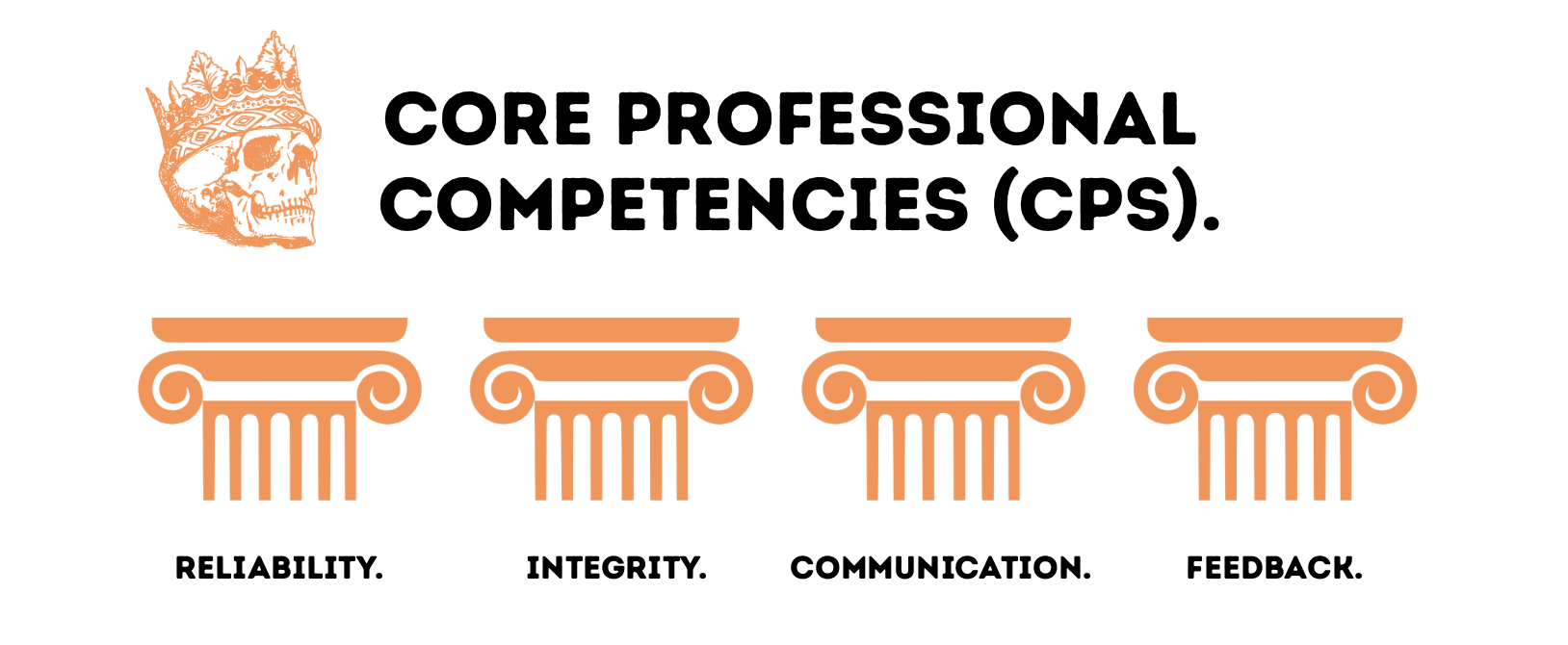
If you want a simple way to remember what actually matters in the workplace, think of the
Big Four: reliability, integrity, communication, and feedback.
Nail these, and you’ll find that most of the other professional competencies fall into place. Reliability earns trust. Integrity protects it. Communication makes it visible. And feedback—both giving and receiving—keeps it growing.
Why these four? Because they are the levers that move everything else. Time management is just reliability applied to your calendar. Teamwork is communication plus integrity. Adaptability is really feedback in action—the humility to adjust when you’re wrong. Even digital literacy is less about tech itself and more about being reliable in how you show up and communicate through modern tools.
You don’t need a hundred rules to be a trusted professional. You need four habits you can practice daily.
1) Show up consistently. 2) Tell the truth. 3) Make your words clear and respectful. 4) Give and receive feedback without ego.
Do these, and you’ll not only check the boxes employers want—you’ll become the kind of person others actually want to work with.
THIS MONTH’S TRAINING.
EACH MONTH, THE PK MEMO FEATURES ONE, ONLINE TRAINING. THE GOAL: MAXIMUM INTERNAL GROWTH IN MINIMUM TIME.
THIS MONTH’S TRAINING:
In this month’s training, you’ll learn how to master the Big Four competencies that shape both your career and your character. What you NEED TO DO to embody
reliability
integrity
communication
feedback
These four habits act like keystones—if you practice them consistently, most other professional skills will fall into place.
We’ll break down each one with simple, actionable steps: how to show up reliably in a way that builds trust; how to anchor your reputation in integrity; how to communicate with clarity and respect; and how to give and receive feedback in ways that fuel growth instead of defensiveness.
You’ll also see how these four overlap—time management, teamwork, adaptability, and even leadership all flow from them.
The goal isn’t theory, it’s practice.
We call this the CPC CODEX, only available to you Kings and Queens.
I made a chart for your fridge!
By the end, you’ll have a short list of disciplines you can apply the same day—whether in the office, in your community, or in your personal relationships.
Nail the Big Four, and you won’t just be employable—you’ll be someone people trust, listen to, and want to follow.

Every professional handbook has its own list of “core competencies.” Ten here, twelve there. Medical schools have one list. Law schools have another. Fortune 500 companies have a third.
But if you trace them all upward, they converge on four deeper habits — what we’ve been calling The Big Four: Reliability, Integrity, Communication, and Feedback.
These four are not just traits; they’re containers. Every professional skill worth having can fit inside them. They’re the scaffolding that holds the rest of your development in place.
This training teaches you how to think, speak, and act in alignment with the big four.
RELIABILITY AS THE ENGINE OF TRUST.
“The truest test of steadiness is found in adversity.”
—Polybius, Histories
Reliability is not a skill you list on your résumé. It’s something people whisper about you in meetings when you’re not in the room: “Give it to her—she’ll get it done.”
It’s quiet. It’s rarely glamorous. But it is the foundation stone of every other professional virtue.
Reliability is the discipline of showing up, following through, and adjusting without excuse. You can have talent, you can have brilliance, but if you can’t be counted on, no one will remember the rest.
In medicine, reliability is literally life and death—checking vitals again even when you’re exhausted. In law, it’s meeting the filing deadline every single time. In education, it’s grading the last stack of essays with the same attention as the first. In business, it’s being the one who keeps your promises when everyone else is running late.
When people can count on you, they stop micromanaging. They relax. And when they relax, they trust—and that’s when collaboration begins. Reliability is a TRUST ENGINE, and it creates a worthy reputation.


WHY RELIABILITY MATTERS…
Reliability is more than punctuality. It’s the intersection of time management, accountability, and emotional stability. When you’re reliable, you’re consistent under pressure.
You communicate early when you’re off track. You own mistakes without spinning them. That predictability builds psychological safety—the single biggest factor in team success.
Reliability also supports adaptability. It’s not rigidity; it’s stability in motion. The most dependable people don’t resist change—they absorb it and recalibrate quickly. That ability to pivot without losing your center is what earns long-term trust.
Reliability also supports adaptability. It’s not rigidity; it’s stability in motion. The most dependable people don’t resist change—they absorb it and recalibrate quickly. That ability to pivot without losing your center is what earns long-term trust.
And here’s the deeper truth: reliability is not just an external behavior; it’s an internal identity. It says, I am a person who keeps their word. That’s integrity’s twin—trust expressed in motion.

Disciplines for Reliability.
Reliability is cultivated through HABITS— disciplines so ordinary that they almost feel beneath mention—but that’s why so few actually do them. Here are some hacks:
1) Routine matters. Build a daily rhythm that prioritizes preparation. Lay out clothes the night before.
2) Review your calendar each evening. Keep a consistent sleep schedule. These small rituals remove the friction that derails reliability.
3) Micro-commitments. Treat even the tiniest promises as sacred. If you say you’ll send a link by the end of the day, do it. Training yourself to take small commitments seriously builds the muscle memory for larger ones.
4) Systems. Use planners, digital calendars, or task managers to externalize memory. No one is reliably excellent on willpower alone—competence is built on systems that catch what your brain might drop.
Reliability isn’t about being perfect; it’s about building a reputation for consistency.
The colleague who gets it right eight times out of ten, and communicates about the other two, will always be valued more than the brilliant but erratic genius who dazzles and disappoints in equal measure.

Aristotle once wrote that excellence is a habit, not an act. Reliability is how that habit begins. You become reliable not through grand declarations but through a thousand small, boring decisions—getting up on time, finishing the report before it’s due, sending the email you said you’d send.
The Stoics called this praxis—the daily repetition of right action. They believed that reliability wasn’t moral decoration; it was the structure of virtue itself. In modern terms: consistency compounds.
An Ancient Insight.

Reliability might look like the smallest of the competencies, but it underpins every other one. Communication fails when reliability breaks. Integrity collapses when promises are forgotten. Feedback loses power when follow-through disappears.
In a chaotic world, reliability is rebellion. It’s saying: “I’ll still show up. I’ll still deliver. You can still count on me.”
And that kind of steadiness is so rare that it becomes leadership all by itself.
And so, remember that reliability is a trust engine. Build it through small, consistent acts, and you’ll power everything else that matters.
Socrates once said, “the greatest path to a good reputation is to be who you pretend to be.” ▲
The Bigger Picture.
A Tool. A Book. A Mantra.
A TOOL.
have historically been a champion of difficult and heavy lifting with cardio on my off days. This past month I have been experimenting with calisthenics (body weight exercises). I came across this baller app called LEO MOVES, which is a calesthenics and mobility based workout app which simultaneously builds muscle. It is so good! Search for it in the app store or go to leomoves.com. Remember: You cannot out exercise a bad diet. Sorry about that last one-- It’s a principle that can work for you or against you. Wink.
A BOOK.
Astrophysics for People in a Hurry by Neil deGrasse Tyson is a mind-blowing book about everything that is and your place within it. I originally picked this up because of a poetry project I was working on (I wanted to make sure my references to the cosmos and physics resonated with current scientific theories). I got more than enough bang for my buck (a BIG bang. get it?). What is spectacular about this book is not just how much it will enlarge your mind in thinking about the universe in which we find ourselves, deGrasse Tyson simultaneously puts a lot of your problems in (very minuscule) perspective. Simplicity is genius, and this book is simply genius. And so I strongly commend it.
A MANTRA.
Voltaire once wrote: “History never repeats itself. Humankind always does.” I think this is a fabulous observation about not just humanity as a species, but my own individual behavior. Basically, I will repeat a problem, process, or habit unintentionally until I seriously take note of it and make a new plan. This is true of how I eat, how I spend money, how I study, how I exercise, and how I grow (or not grow). What about you? Are there ways history is repeating itself simply because of default behaviors? Einstein once said that doing something the same way every time while expecting a different result is the definition of insanity. So... there you go. Two for one.


Integrity: Your Moral Operating System in a Noisy World.
Integrity is your destiny.
It is the light that guides your way.
—Plato

In a culture obsessed with performance, integrity is strangely underrated. We reward cleverness, visibility, and hustle—but integrity? It rarely trends. Yet without it, every achievement eventually collapses. Integrity isn’t about image. It’s about alignment—your actions, words, and values all pointing in the same direction, even when no one’s watching.
Integrity is your moral operating system. It runs quietly in the background, keeping everything else stable. You don’t notice it when it’s working—but when it crashes, the whole enterprise fails.
The tricky part about integrity is that it’s not tested when life is easy. It’s tested when you’re under pressure, tired, tempted, or afraid. It’s tested when cutting corners looks efficient, or when silence seems safer than truth. The people who thrive long-term are the ones who choose integrity when it’s inconvenient.

Integrity at work.
In professional life, integrity shows up everywhere:
In ethical decision-making—whether you stretch the numbers or tell the truth.
In professionalism—how you treat clients, coworkers, and support staff when there’s nothing in it for you.
In empathy and inclusion—whether you practice fairness when it costs comfort.
In digital conduct—what you post, forward, or tolerate online.
A breach of integrity rarely announces itself with fireworks. It creeps in quietly—a small lie, a small omission, a small disrespect. But every small compromise trains you to tolerate the next one. Eventually, you stop noticing when you’ve drifted.
That’s why the philosopher Plutarch said, “Character is long-standing habit.” Integrity is built not by speeches but by repetition. Every honest decision—every truth told when it would be easier not to—etches reliability into your identity.

The Emotional Side of Integrity.
Integrity isn’t only moral; it’s emotional. When your internal compass aligns with your external behavior, you experience peace. When it doesn’t, anxiety festers. Your mind starts to split between who you are and who you’re pretending to be.
This misalignment bleeds into relationships, performance, and self-respect. Integrity, then, is less about looking righteous and more about staying whole. It’s psychological integration—the foundation of what ancient philosophers called eudaimonia, the flourishing life.

Integrity in Practice.
Tell the truth, even when it costs you.
Integrity is expensive—but every honest act buys credibility. In time, credibility compounds into influence.Protect confidentiality.
Keep private things private. In an age of screenshots and leaks, discretion is a rare and valuable currency.Model respect.
Treat every person with dignity—especially those you don’t need. That’s how others learn what leadership feels like.Clean up your digital life.
Audit your online footprint. Delete sarcasm, gossip, or reactive posts. Speak online the same way you would face to face.Do the invisible work.
Return the cart. Refill the coffee pot. Fix the typo no one else saw. The small acts of integrity build the reputation that big ones depend on.

Integrity and Inclusion.
There’s another layer to modern integrity: empathy across difference. In a global and hybrid world, you will work alongside people whose cultures, histories, and beliefs are not yours. Integrity requires curiosity instead of fear, listening instead of judgment.
This is where integrity overlaps with emotional intelligence—the awareness of how your actions land on others. You can’t claim moral excellence if your behavior alienates or harms people from whom you never learned to listen.
The Stoic philosopher Hierocles wrote about the “circles of concern”: the idea that moral maturity means drawing those circles wider, including more people within our care. True integrity widens the circle—it refuses to dehumanize.

So What— The Practical Difference.
When you live with integrity, people sense it. You become safe to trust, even in tense situations. You become the colleague who grounds the room. And that kind of steadiness attracts responsibility. Promotions, leadership roles, mentorships—they all go to those who can be trusted with power.
In contrast, the smallest cracks in integrity eventually shatter opportunity. Gossip once in a while. Manipulate outcomes once in a while. Shade the truth once in a while. Each act feels small—but the trust you lose never returns at full strength.
So the work is simple but endless: align your words, actions, and motives. Build habits that make you proud of your reflection. Decide in advance who you will be when the pressure hits—and then practice it in the small moments until it becomes your default.
A Closing Insight.
Integrity isn’t loud. It doesn’t demand recognition. But over time, it builds something louder than applause: credibility. And credibility, once earned, will carry you further than talent ever could.
🔥 PK Takeaway:
Integrity is the moral operating system of adulthood. Protect it. Update it. And keep it running clean. ▲

COMMUNICATION: THE CORE SKILL OF LEADERSHIP AND THE MEDIUM OF TRUST.
IF RELIABILITY BUILDS TRUST, COMMUNICATION KEEPS IT ALIVE.
If reliability builds trust, communication keeps it alive. It’s the bloodstream of every organization—the current that carries ideas, expectations, and emotion from one mind to another. And like any bloodstream, if it clogs or turns toxic, the whole body suffers.
Most professionals think communication is about talking. But at its core, it’s about translation—turning your thoughts into language other people can use. Clarity and tone are not decoration; they’re the bridge between your intent and another person’s understanding.
When communication fails, everything else unravels. Projects stall. Teams splinter. Leaders lose credibility.
But when it hums, people align, creativity sparks, and trust compounds.

Demosthenes, the greatest orator of Athens, once said,
“What we must first do is to think what we would say; for when the thought is right, the words will follow easily.”
It’s a perfect summary of professional communication. Before you speak, slow down enough to think clearly.
Ask: What am I really trying to say? What do I need the other person to understand, feel, or do?
That pause is the birthplace of clarity.

HERE’S WHY COMMUNICATION MATTERS WHY SO MUCH…
Communication is not one competency among many—it’s the one through which all the others express themselves.
Integrity without communication looks aloof.
Reliability without communication looks robotic.
Feedback without communication is impossible.
Good communication is both technical and human:
Technical clarity—structuring information, choosing the right channel, proofreading your words.
Human empathy—noticing tone, reading non-verbals, and framing truth in ways people can receive.
In digital life, these blend. Slack threads, Zoom calls, emails, AI notes—your words now travel farther and faster than you do. Your digital presence is your professionalism on display. Write clearly. Respond promptly. Remember that tone bleeds through text.

Teamwork also lives or dies by communication.
When people feel heard, they engage. When they feel ignored or misunderstood, they withdraw.
Listening—really listening—is oxygen for collaboration.
Leadership is advanced communication. The best leaders don’t just inform; they align. They create meaning, not noise. They know when to speak to the room and when to walk down the hall for a one-on-one.
Cultural awareness also depends on communication. Empathy across difference begins with curiosity: asking before assuming, translating before judging. A single respectful question can defuse what hours of argument cannot.
Even writing a memo for Philosopher Kings or a Past Forward podcast episode requires immense clarity. This means knowing exactly what I want to say, the structure it needs to have to be clear, and defining what a win looks like. By defining the win, I mean that I know precisely what I want the result to be as a direct result of the communication. Here are some hacks for becoming trusted, safer, clearer, and more impactful.
The discipline of clear and concise communication.
Start with structure.
Before you write or speak, outline the key point and the outcome you want.
A one-sentence summary saves everyone time.
Shorten everything.
Draft long, edit short. Every unnecessary word is static in the signal.
What exactly needs to be communicated? What just gets in the way of that message?
Check tone, not just grammar.
Ask yourself: Would I want to receive this message on a stressful day?
Tone is the difference between collaboration and conflict.

Listen like a designer.
Designers gather feedback before they ship the work. Do the same—mirror back what you heard before reacting.
This can prevent 80% of workplace misunderstandings.
Communication and Emotional Intelligence.
The mature communicator doesn’t just broadcast; they attune. They sense energy in a room, name tension before it escalates, and translate emotion into action. This is emotional intelligence in motion.
It’s also humility: the recognition that your meaning lives in their interpretation. No matter how smart your phrasing, the message only exists once it’s received.
So communication is less about sounding brilliant and more about being useful. Every sentence should serve someone.
The Bigger Picture.
When you master communication, you don’t just exchange information—you shape culture.
Your meetings get shorter. Your emails get answered. Your relationships get deeper.
And eventually, people start coming to you before the meeting, because they trust you’ll help them think clearly. That’s the quiet moment when communication turns into leadership.
🔥 PK Takeaway:
Communication is how competence becomes visible. Think first, speak clearly, listen fully—and you’ll build the kind of trust that travels faster than your title. ▲

FEEDBACK: THE ENGINE OF GROWTH AND THE LIFEBLOOD OF COMPETENCE.
Most people say they want to grow—until growth feels like correction.
Feedback is the friction that makes you better, but it’s also the mirror most of us avoid. It reveals the gap between who you think you are and how you actually show up.
In the modern workplace, feedback is oxygen. It keeps learning alive, performance sharp, and teams honest. Without it, people plateau quietly. Projects drift. Cultures decay.
With it, energy circulates—people adapt, connect, and improve faster than the system around them.
Feedback, in other words, is not a side conversation. It’s the engine of competence itself.
The Greek physician Galen once wrote,
“The best physician is also a student of his own practice.”
That’s the essence of feedback. You can be skilled, experienced, even excellent—but you are never finished. The moment you stop examining your own practice, you stop evolving.

How to Give and Take Feedback and See it as a Necessary Part of Growth.
Our ego hates it. Even the gentlest critique can feel like an existential threat. But the most competent professionals are the ones who’ve trained themselves to stay open—to resist defensiveness and translate feedback into improvement.
Receiving feedback well means three things:
Listening without rebuttal. Let the words land before you explain yourself.
Thanking before reacting. Gratitude disarms the critic and re-centers your composure.
Reflecting before responding. Take time to separate the emotional sting from the useful signal.
When you respond with humility instead of heat, you tell people you’re coachable. And coachable people get promoted, mentored, and trusted.
01
Giving Feedback
Giving feedback is leadership in miniature. It’s how you help others see what they can’t yet see. But it requires precision and empathy.
Start with intent—why are you giving it? To help, not to humiliate.
Then use specificity—describe behaviors, not personalities.
Finally, end with direction—offer a path forward, not just a critique.
The best feedback feels like light:
it reveals without burning.
02
Feedback as Adaptability
Feedback and adaptability are twins. Adaptability is your response to reality changing; feedback is how you find out that it has.
In fast-moving environments—medicine, education, tech, leadership—adaptability is the difference between relevance and obsolescence.
Treat feedback as data, not judgment. The moment you stop personalizing it, you can start learning from it. That’s how you build resilience.
03
Teamwork and Feedback
Teams that learn to trade feedback respectfully create what psychologists call psychological safety—a climate where it’s safe to tell the truth.
In those environments, innovation thrives. Mistakes become experiments, and performance grows naturally because no one’s hiding.
In contrast, teams that avoid feedback—out of fear or pride—grow silent and stagnant.
That’s why, as a professional, you can’t wait for perfect cultures to form. You have to model the safety you wish you had. Ask for feedback. Give it well. Be the person who normalizes growth.
THE DAILY PRACTICE OF FEEDBACK.
Here’s what to actually do:
Ask for feedback before it’s offered.
Try: “Hey, what’s one thing I could do better on this project?” That phrasing lowers defenses and invites honesty.Keep a learning log.
Write down feedback patterns you hear. When the same theme repeats, that’s a growth target.Separate content from tone.
Even poorly delivered feedback can contain truth. Don’t let clumsy phrasing make you miss insight.Pay it forward.
When you see someone doing well, name it specifically. Positive feedback reinforces excellence faster than criticism prevents mistakes.
The Bigger Picture
Feedback is what keeps competence alive. It closes the loop between effort and reality. It’s how you stay humble without staying small.
In time, you’ll realize that the people who grow the fastest aren’t the most talented—they’re the most teachable. They live like Galen’s physician: still a student, still refining, still listening.
“He who would learn must first learn to listen.” — Zeno of Citium
That’s the soul of professional growth. Listening deeply enough to change.
🔥 PK Takeaway:
Feedback is the engine of growth. Invite it early. Give it well. And use it to turn potential into mastery. ▲


Other Ways To Grow.
Here are some more ways to progress yourself with the Philosopher Kings Platform.
-
PAST FORWARD. THE PHILOSOPHER KINGS PODCAST.
The “Past Forward” Podcast brought to you by Philosopher Kings, where ancient wisdom meets modern ambition. The show draws from timeless philosophy, mythology, and classical thought to help young professionals lead with clarity, character, and purpose. What if in ten minutes on your commute you could learn to think, speak, and act with knowledge, wisdom, and virtue (become a Philosopher King...). If you're hungry for more than productivity hacks— and ready to think, speak, and act with depth— you're in the right place. It’s time to move your life past forward.
-
THE PHILOSOPHER KINGS YOUTUBE CHANNEL.
The Philosopher Kings Youtube Channel takes the best of philosophy, mythology, and timeless psychology to help young professionals grow in clarity, character, and calm. From Epictetus to the Stoics, from Plato to practical habits— this channel gives you the mindset tools and inner framework to lead wisely and live meaningfully. If you want to think deeper, show up better, and build a life that actually matters— you’re in the right place.
-
THE PHILOSOPHER KINGS BLOG.
The Philosopher Kings Blog is where deep thinking meets real professional and personal life. We explore ancient philosophy, timeless stories, and practical frameworks to help modern professionals build wisdom, emotional intelligence, and ethical clarity. If you want more than hacks and hustle— if you're after meaning, mastery, and a life well-lived— this is your corner of the internet.